
Investment Highlights July 2026: Southeast Asia's Exit Window Swings Wide Open
Investment Highlight Southeast Asia SEA 7 Minutes
If June was the month Southeast Asia poured concrete for its AI backbone, July is the month the region reminded everyone why it built it in the first place: to create real companies that can list, exit, and return capital. The headline energy this month is unmistakable: the Philippines is charging toward its biggest IPO in history, a Vietnamese fintech unicorn is fielding buyout suitors, and capital is finally starting to spread beyond the data-centre giants into robotics, insurtech and AI-native software rounds across the region.
This is the maturing, disciplined, quietly confident Southeast Asia that long-term builders and investors have been waiting for. Here's what mattered in July, and what it means for you.
The backdrop: a record first half, and a market that knows its own story
Before we get to July's action, it's worth framing where the region stands. According to Tracxn's H1 2026 data, Southeast Asian tech companies raised roughly $7.65 billion in the first half of 2026, more than double the $3.54 billion of a year earlier, a jump of about 116%. On its face, that's a blockbuster recovery.
But the region has grown too smart to be dazzled by a single number. A large slice of that total went to one company, Singapore data-centre operator DayOne, whose Series C rounds alone accounted for roughly $4.5 billion. Strip that out and the picture is far more measured, with Singapore alone absorbing well over 90% of everything. There were 12 rounds of $100 million or more in H1, up sharply from just four in the second half of 2025, and late-stage deals took the lion's share of the capital.
The read is simple and, honestly, encouraging: capital is concentrating into fewer, larger, higher-conviction bets. June itself hit a four-year high of $4.22 billion across 41 deals (the first time regional funding crossed $4 billion since November 2021), with five megadeals (DayOne, Supabase, Acrab, Airwallex and Vietnam's Vinpearl) accounting for 93% of the disclosed total. The tourist capital of the early 2020s is gone. What's left is patient money that wants proof. July's story is what happens next: that proof starting to pay out.
The exit window swings wide open
For years, the biggest question hanging over Southeast Asian venture has been the same one: where do the returns come from? July delivered the most exciting answer in half a decade.
GCash is having its "SpaceX moment." Mynt, the parent of the Philippines' dominant mobile wallet GCash, backed by Globe Telecom, Ant Group, MUFG, Ayala Corp and Mitsubishi, is advancing toward a listing on the Philippine Stock Exchange that could raise up to $1.5 billion (about ₱92.3 billion) at an indicative price of up to ₱10.00 per share. The offer represents roughly 12% of the company, and following its June 27 prospectus filing, the timetable has firmed up: the offer period is slated for October 5 to 9, with listing under the ticker "GCASH" targeted for October 19. If it prices at the top of its range, it would be the largest IPO in Philippine history, comfortably eclipsing Monde Nissin's $1 billion debut in 2021. One local banker called it the market's "SpaceX moment," and the enthusiasm is contagious: Globe Telecom's shares jumped in the days after the filing. GCash reached about 40.4 million monthly active users as of March 2026, an estimated 55% of the country's adult population, and grew adjusted revenues to roughly ₱79.7 billion in 2025. This is a genuine, profitable, mass-market champion going public on home soil.
Vietnam's MoMo is fielding buyout interest. Financial and strategic investors have reportedly been conducting due diligence on the Vietnamese fintech unicorn in what could become one of the country's largest private-equity-backed tech transactions. It's another signal that mature SEA fintech now has real exit optionality, not just IPOs but strategic and PE liquidity too.
The data-centre boom is minting exits, not just rounds. The infrastructure wave that dominated headlines all year is now producing M&A: KKR and Singtel's roughly $5.2 billion acquisition of ST Telemedia Global Data Centres and BizLink's $900 million purchase of Interplex both landed in H1, and the Philippines is lining up its own data-centre REIT listings on the back of the trend. Buildout is becoming realized value.
For anyone who has held conviction in this region through the lean years, this is the payoff chapter beginning to write itself.
Capital broadens: robotics, insurtech and AI-native software
The most heartening theme of July isn't the megadeals; it's the spread. After eighteen months where compute and data centres soaked up the oxygen, fresh cheques are flowing into a much wider set of founders.
- Amity Robotics (Thailand) kicked off the month with a $7 million seed round (blending equity and debt) to scale its physical-AI concierge business. Its ARC Base kiosks are already live across 30-plus properties from Singapore to Saudi Arabia, and the raise funds ARC Move, its first mobile robot. Physical AI is quietly becoming a real SEA category.
- PolicyStreet (Malaysia) grew its Series C to $26 million with a fresh $5 million injection from impact investor BlueOrchard, extending its digital insurance reach across Asia and Australia. Malaysian insurtech continues to punch above its weight.
- SimpleAI (Singapore) raised $5 million in seed funding plus a $10 million debt facility to pursue acquisition-led growth in accounting automation across APAC: a smart, capital-efficient roll-up play in exactly the kind of "boring but essential" software investors now love.
- Atome Philippines secured an $81 million wholesale funding facility from Asia United Bank, deepening consumer-finance liquidity in one of the region's fastest-growing digital markets.
- Omio committed a €8.7 million strategic investment to accelerate its Southeast Asian expansion, anchored by an AI-focused technology hub in Singapore, a reminder that global players increasingly build from the region, not just sell into it.
Notice the pattern: seed-and-strategic rounds, disciplined cheque sizes, clear revenue logic, and a strong tilt toward AI applied to real workflows across finance, insurance, logistics and physical spaces. This is what a healthy, maturing ecosystem looks like from the ground up.
Fresh oxygen for early-stage founders
Perhaps the best news for the next generation of builders: the top of the funnel is being deliberately refilled.
On July 22, the Asian Development Bank's venture arm, ADB Ventures, launched the Southeast Asia Emerging Entrepreneurs Kickstart (SEEK) with Japan's JICA, offering seed funding of up to $400,000 to startups tackling clean energy, smart mobility, inclusive finance, agri, circular economy and the digital economy across Southeast Asia and the Pacific. Malaysia, meanwhile, has been the region's early-stage bright spot for much of 2026, ranking second in SEA by deal count on the strength of seed activity, while Vietnam continues to build momentum with 4,000-plus startups, active state backing, and a national push to attract global capital for a $1.5 trillion infrastructure agenda.
The message to founders: yes, the late-stage cheques are bigger and the bar is higher, but the region's institutions, DFIs and governments are actively engineering more first cheques, not fewer.
What it all means for founders and investors
Three takeaways from July, and how to act on them.
1. The exit window is real, so build to be exit-ready now. GCash and MoMo prove that Southeast Asian companies can list and attract serious strategic capital. But IPOs and PE processes reward companies with clean, defensible foundations: an accurate, audit-ready cap table, a well-structured ESOP with a sensible vesting schedule, defensible 409A valuations, and financials a diligence team can trust. If your equity story is messy, the exit window closes on you specifically. Get your house in order long before you need to.
2. Discipline is the price of admission. With capital concentrating into higher-conviction rounds, seed and Series A founders can no longer coast on growth-at-all-costs. Investors want clear unit economics, real revenue, and evidence you can do more with less. Instruments like SAFEs and convertible notes keep early raises fast and founder-friendly, while a fractional CFO and a tight financial model signal the operational maturity today's investors reward. Fundraising in 2026 is a flight to quality, so position yourself on the right side of it.
3. For investors, the region has decoupled, but you need deal flow and clarity. Southeast Asia is offering something rare right now: maturing exits, disciplined valuations, and broadening sector opportunity from robotics to insurtech to inclusive finance across Singapore, Malaysia, Indonesia, Vietnam, the Philippines and Thailand. The winners will be those with genuine deal flow, clean data rooms, and the ability to move fast when a high-conviction opportunity appears.
This is where WOWS Global sits at the center of the action. Our platform connects founders and investors across Southeast Asia through investor matchmaking and a live deal-flow network, while giving companies the equity-management backbone (cap table management, ESOP administration, 409A and company valuations, and fundraising tools) that turns a promising startup into an exit-ready one. Whether you're a founder preparing your next round or your eventual IPO, or an investor hunting for the region's next GCash, the infrastructure to do it well matters more than ever.
Southeast Asia spent the last few years proving it could build. In July 2026, it started proving it can return. For everyone betting on this region, that's the most exciting signal of all.
Want to get your cap table, ESOP and valuations exit-ready, or connect with the right investors for your next round? Explore WOWS Global and see how founders and investors across Southeast Asia are getting funded and getting ready.
Related Posts
-
Fractional CFO Business Founders Southeast Asia 6 Minutes
Fractional CFO Cost: Rates and Engagement Models in 2026
Understand fractional CFO costs in 2026, including monthly retainers, hourly rates, project fees and part-time engagement models. This guide explains what affects pricing, what to expect from a CFO engagement and how to choose the right financial support for your business. -
AI Investment Southeast Asia Capital 4 Minutes
Investment Highlights August 2026: Southeast Asia's Big-Check Era Takes Hold
The money is back in Southeast Asia, and it's arriving in bigger checks than ever. Capital jumped 137% to $12.8B this year while deal count fell 30%. Inside: Acrab's $130M AI raise, three blockbuster IPOs, and what the flight-to-quality market means for your next round. -
Investment Highlight SEA AI 6 Minutes
Investment Highlights June 2026: Southeast Asia Builds the AI Backbone While the Exit Window Cracks Open
Southeast Asia's June 2026 was deliberate, not euphoric. Capital concentrated around the AI infrastructure buildout, deep tech and health tech kept punching above their weight and, for the first time in three years, the exit window cracked open with GCash parent Mynt filing for a record US$1.5 billion IPO. We break down the deals that mattered, who's writing the cheques and what it all means for founders and investors. -
SEA Investment MENA Private Credit Fintech 7 Minutes
Investment Highlights May 2026: SEA Puts Data Centres on the Balance Sheet While MENA Turns Credit Into Infrastructure
May’s investment activity across SEA and MENA shows capital is still moving, but with sharper discipline. From data centres and green infrastructure in Southeast Asia to private credit and fintech rails in MENA, investors are backing companies with stronger fundamentals and clearer capital stacks. -
Emerging Markets SEA Bangkok Events Investment 3 Minutes
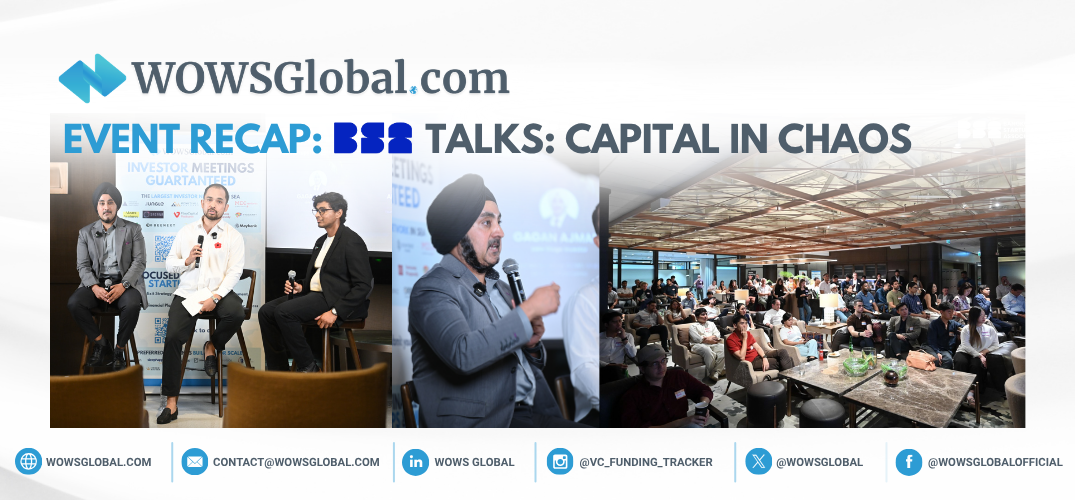
WOWS Global's Gagan Ajmani joined Bangkok Startup Association's Capital in Chaos event to unpack fundraising discipline, investor readiness and traction today.
At Capital in Chaos in Bangkok, WOWS Global CEO Gagan Ajmani discussed how founders can raise smarter in uncertain markets by focusing on traction, track record, investor readiness, and the right funding path for their business. -
SEA MENA Highlight Investment Funding 5 Minutes
Investment Highlights April 2026: SEA Builds The Rails And MENA Turns Credit Into Product
April’s startup funding story was not about fireworks. It was about rails. Across SEA and MENA, investors backed infrastructure, credit, climate, AI and regulated platforms with clearer paths to scale.