
A Guide to Southeast Asia's Most Active VCs
Venture Capital Southeast Asia Startup Investor 9 Minutes
Southeast Asia has become one of the world’s most closely watched startup regions. With a young digital-native population, rising consumer demand, fast-growing enterprise adoption and markets that are still underpenetrated across financial services, healthcare, logistics, climate and software, the region continues to offer long-term opportunities for founders and investors alike.
But the venture capital landscape in Southeast Asia has changed. The easy-money years have given way to a more selective market, where capital is moving with greater discipline. Investors are paying closer attention to profitability, capital efficiency, defensible business models and the quality of founder execution. For startups, this means that identifying the right capital partner is no longer just about finding who is writing cheques. It is about finding investors with conviction, regional expertise, follow-on capacity and the networks to help companies scale across fragmented but high-potential markets.
For investors, the region remains compelling for a different reason. Southeast Asia is not a single market. It is a collection of economies with different consumer behaviours, regulatory environments, talent pools and capital pathways. The venture firms that matter most are often those with local operating knowledge, cross-border relationships and the ability to spot companies that can expand beyond their first market.
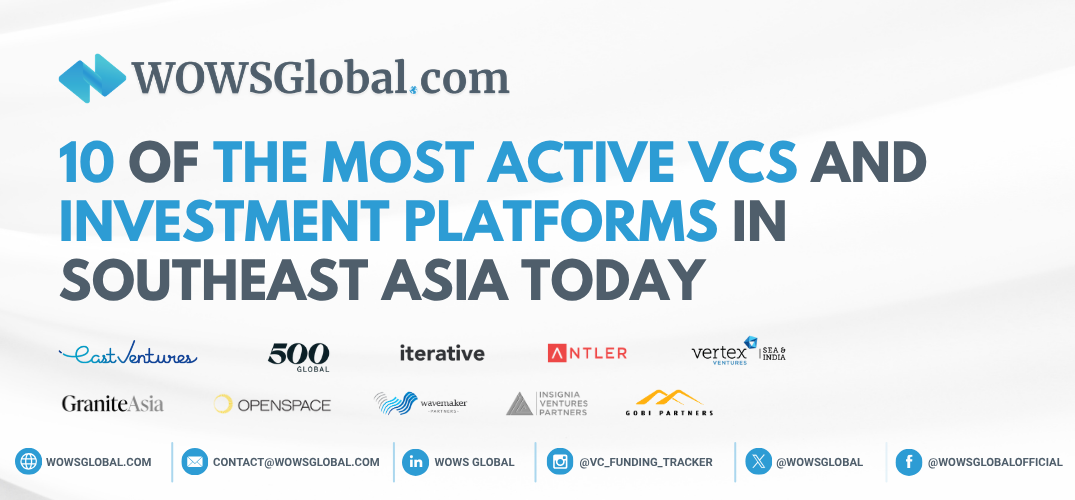
Below are ten of the most active and influential venture capital firms and investment platforms shaping Southeast Asia’s startup ecosystem.
10 Of The Most Active VCs In Southeast Asia
Now that the scene is set as to why the Southeast Asian region is so attractive to startups and VCs alike, here are 10 of the VC firms that are most active in this region:
East Ventures
East Ventures is one of Southeast Asia’s most established homegrown venture capital firms. Founded in 2009, the firm has built a deep reputation for identifying promising founders early and supporting them across multiple stages of growth.
Its roots are especially strong in Indonesia, Southeast Asia’s largest economy by population and one of the region’s most important digital markets. Over the years, East Ventures has expanded into a broader regional platform, backing companies across sectors including commerce, fintech, software, healthcare, climate and consumer technology.
What makes East Ventures particularly relevant is its proximity to founders. In Southeast Asia, where market access, regulation, distribution and local partnerships often matter as much as product quality, the firm’s on-the-ground network gives it a meaningful edge. It has backed more than 300 technology companies across the region and continues to operate as a sector-agnostic investor from seed to growth stage.
For investors watching Southeast Asia, East Ventures is a strong barometer of where local conviction is forming. Its activity often reflects emerging founder momentum in Indonesia and the wider region, from early digital adoption to more mature themes such as sustainability, health and productivity infrastructure.
500 Global / 500 Southeast Asia
500 Global remains one of the most recognisable early-stage investors in Southeast Asia. The firm made its first Southeast Asian investment in 2012 and later began deploying dedicated regional capital through its Southeast Asia funds.
Its strength lies in breadth. 500 Global’s Southeast Asia strategy has backed hundreds of companies across multiple countries and sectors, giving it one of the broadest early-stage footprints in the region. That matters in a market as diverse as Southeast Asia, where the next breakout company may come from Singapore, Indonesia, Vietnam, Malaysia, Thailand, or the Philippines.
The firm has played a role in backing companies that went on to become major regional names, including Grab, Bukalapak, Carousell, Carsome, FinAccel and eFishery. Its approach combines early-stage capital with founder programming, global networks and exposure to follow-on investors.
For founders, 500 Global is often seen as a gateway into a wider investor ecosystem. For investors, its portfolio provides a useful read on early-stage activity across the region. Its scale and distribution make it one of Southeast Asia’s most important startup pipeline builders.
Granite Asia
Granite Asia is a Singapore headquartered multi strategy investment platform investing across venture, growth equity, and private credit. The firm has a broad regional mandate covering Southeast Asia, China, Japan, South Asia, and Australia, and has been active in seed to growth stage investing across Southeast Asia for more than two decades, with its Singapore office playing a key role in regional deal flow since 2019.
In terms of scale, Granite Asia appears to be materially larger than many of the firms currently featured in the article. It manages approximately USD 10 billion in assets, compared with Gobi Partners at around USD 1.5 billion, Wavemaker Partners at roughly USD 300 million, Openspace Ventures at around USD 500 million, and Golden Gate Ventures at approximately USD 250 million. This places Granite in a different category from most regional VC platforms.
Granite Asia’s track record is also significant. The firm has supported 48 companies that reached valuations above USD 1 billion and has facilitated 65 IPOs globally. Its portfolio includes major technology companies such as Grab, Alibaba, Xiaomi, ByteDance, and Didi, giving it exposure to some of the most important companies built across Asia’s digital economy.
The firm is also actively strengthening its Southeast Asia presence through recent strategic partnerships. These include a USD 1.2 billion partnership with the Indonesia Investment Authority to support digital transformation in Indonesia, a USD 110 million AI focused IPO fund with DBS, and the annual NextGen Tech 30 program, which highlights promising growth stage companies across Asia. Overall, Granite Asia’s scale, track record, and regional activity make it a strong candidate for inclusion alongside the leading investment platforms in Southeast Asia.
Iterative
Iterative has quickly become one of the most important early-stage platforms in Southeast Asia. Built in the style of a startup accelerator, the firm focuses exclusively on founders in the region and invests up to US$500,000 in batches of startups twice a year.
That batch-based model gives Iterative a high-volume view of founder formation across Southeast Asia. The firm works closely with admitted startups for several months before connecting them with a wider investor network through Demo Day. In a market where first-time founders often struggle to access capital, mentorship and investor visibility, Iterative plays an important role in making the early-stage ecosystem more efficient.
Its recent batches have drawn significant applicant interest, with companies spanning AI, SaaS, robotics, fintech, commerce enablement and other technology-driven sectors. This reflects a broader shift in Southeast Asia: founders are no longer building only consumer apps for local markets. Increasingly, they are building infrastructure, automation and software products that can serve regional or global customers.
For investors, Iterative is worth watching because it sits close to the source of new company creation. Its activity can provide an early signal of which founder themes are gaining traction before they become visible in larger funding rounds.
Antler
Antler has become a major force in Southeast Asia’s earliest stages of company formation. Founded in Singapore, the global early-stage investor operates founder residency programmes across the region, backing entrepreneurs from “Day Zero” through pre-seed and seed stages.
Its Southeast Asia Fund II closed at US$72 million, giving Antler fresh capital to support founders across markets including Singapore, Indonesia, Vietnam and Malaysia. The firm’s model is designed to meet founders before a company is fully formed, helping them refine ideas, build teams, validate markets and prepare for institutional fundraising.
This approach is particularly relevant in Southeast Asia, where many high-potential founders may have strong domain knowledge but limited access to venture networks. By investing early and often, Antler has become one of the region’s most visible platforms for turning talent into fundable companies.
For investors, Antler’s value lies in its deal-flow engine. It captures founders at the earliest point in the startup lifecycle and provides a structured pathway from idea to investor-ready business. In a more selective funding market, that kind of founder filtering and preparation becomes increasingly important.
Vertex Ventures Southeast Asia & India
Vertex Ventures Southeast Asia & India brings institutional scale and regional credibility to the venture landscape. The firm closed its fifth fund at US$541 million, exceeding its original target and giving it significant capacity to invest in high-potential startups across Southeast Asia and India.
In Southeast Asia, Vertex is best understood as a serious early institutional investor. It typically focuses on companies that have moved beyond the idea stage and are ready to scale with stronger governance, sharper commercial execution and larger capital requirements. Its preferred position around Series A gives it a critical role in helping companies move from early traction to regional expansion.
The firm has a strong reputation for leading rounds, taking board seats and working closely with founders. That matters in a market where founders need more than capital; they need partners who can help with hiring, fundraising, market entry, financial discipline and strategic decision-making.
For investors, Vertex is one of the region’s important conviction-led players. Its activity is especially relevant for those tracking which startups are moving from seed-stage promise into the next layer of institutional growth.
Openspace Capital
Openspace Capital is a multi-strategy asset manager with a specialist focus on Southeast Asia. The firm manages approximately US$800 million in committed capital across six funds and invests in tech-native and tech-enabled companies across multiple stages.
The firm’s positioning reflects the maturation of the Southeast Asian market. While many early venture firms focus primarily on first institutional capital, Openspace is built to support companies across different capital needs, from early-stage venture to growth equity and adjacent strategies. This allows it to stay close to companies as they scale, encounter new financing requirements and expand across the region.
Openspace has backed companies in sectors such as fintech, healthtech, commerce, insurance, climate and mobility. Its approach combines investment capital with operational support, helping founders navigate market expansion, talent, governance and business model development.
For investors, Openspace is a useful lens into Southeast Asia’s middle stage — the critical phase between seed-stage experimentation and late-stage institutional scale. This is where many companies either prove they can become regional leaders or struggle with the complexity of fragmented markets. Openspace’s multi-stage view makes it one of the region’s more important long-term capital partners.
Wavemaker Partners
Wavemaker Partners has built one of the most distinctive venture strategies in Southeast Asia. Rather than concentrating mainly on consumer internet, the firm has long focused on enterprise, deep tech and sustainability, sectors that are increasingly relevant as the region’s startup ecosystem matures.
Since 2012, Wavemaker has backed more than 200 companies across Southeast Asia and manages hundreds of millions of dollars across multiple vehicles, including Wavemaker Ventures, Wavemaker Impact and Wavemaker Growth. This structure allows the platform to support companies solving different types of problems, from enterprise software to climate and industrial transformation.
Wavemaker’s thesis has aged well. Southeast Asia’s next wave of startup value is unlikely to come only from consumer platforms. It will also come from companies building infrastructure, automating legacy industries, improving supply chains, decarbonising operations and helping businesses become more productive.
For investors, Wavemaker is worth watching because it often backs companies that sit outside the most obvious venture narratives. Its focus on defensible, problem-led businesses makes it especially relevant in a market where capital efficiency and real customer demand now matter more than growth optics alone.
Insignia Ventures Partners
Insignia Ventures Partners is one of Southeast Asia’s leading early-stage venture capital firms. Founded in 2017, the Singapore-based firm backs technology companies from seed through growth, with a focus on founders building market-leading businesses across the region.
The firm raised US$516 million across its third venture fund and related vehicles, giving it meaningful capacity to support early-stage companies as they scale. Its portfolio includes companies across fintech, commerce, software, AI, digital infrastructure and consumer platforms.
Insignia’s strength lies in its founder-first approach and its understanding of Southeast Asia’s operating complexity. Building in the region requires more than product-market fit in one city or country. Companies often need to navigate cross-border expansion, localisation, regulatory nuance, payments infrastructure, hiring challenges and uneven customer behaviour. Insignia’s role is often to help founders manage that transition from early traction to durable regional growth.
For investors, Insignia offers a window into Southeast Asia’s emerging category leaders. Its portfolio and thought leadership frequently track themes that matter across the region, including fintech infrastructure, AI adoption, regional commerce and the globalisation of Southeast Asian startups.
Gobi Partners
Gobi Partners is one of Asia’s most experienced venture capital firms, with a long operating history across emerging and underserved markets. Founded in 2002, the firm has grown into a pan-Asian platform with a presence across multiple markets and a portfolio spanning hundreds of companies.
The firm manages approximately US$2 billion in assets under management and has backed more than 400 companies, with dozens of exits across Asia. Its footprint gives it a broad perspective on how technology adoption develops across different market environments, from more mature ecosystems to frontier growth markets.
In Southeast Asia, Gobi is particularly relevant for its focus on emerging markets, financial inclusion, sustainability and underserved founders. Its recent strategic investment in Funding Societies, one of Southeast Asia’s largest SME digital finance platforms, reflects continued interest in fintech infrastructure and access to capital for small and medium-sized businesses.
For investors, Gobi offers a long-cycle view of venture capital in Asia. It has operated through multiple market cycles and continues to back companies where technology intersects with inclusion, productivity and sustainable growth. That experience is especially valuable in a region where patience and local nuance often determine outcomes.
What Investors Should Watch in Southeast Asia
Southeast Asia’s venture market is becoming more disciplined, but that does not make it less attractive. In many ways, it makes the region more interesting for long-term investors.
The next cycle is likely to reward companies with clearer monetisation, stronger unit economics and deeper market understanding. Fintech remains a major theme, especially where startups are solving credit, payments, compliance, wealth and SME financing gaps. AI is becoming more relevant, but the strongest opportunities may come from practical applications in enterprise workflows, customer operations, manufacturing, education, logistics and financial services. Climate, energy efficiency, healthcare and supply-chain resilience are also becoming more investable as governments, corporates and consumers demand more sustainable solutions.
The region’s complexity is still its greatest challenge. Southeast Asia is fragmented across languages, regulations, currencies, consumer behaviours and infrastructure maturity. But that same complexity creates openings for companies that can solve local problems well and then expand with discipline.
For investors, the most important question is no longer whether Southeast Asia has potential. It clearly does. The better question is which founders, sectors and capital partners are best positioned to convert that potential into durable outcomes.
For Southeast Asian Founder Seeking Funds - Help Is At Hand
The 10 most active VCs in Southeast Asia mentioned above are not alone. The region is currently witnessing a very healthy upsurge in venture capital companies and equity investors looking to invest in startups from a wide range of business sectors.
Smart startup founders will be aware of the importance of securing those much-needed funds. Money that will propel their business through structured and healthy growth cycles. However, finding the right type of investor for your startup is easier said than done.
This is where WOWS Global comes in. Our highly experienced team is ready to assist you through every step of your startup journey. We have developed a secure, state-of-the-art, online digital ecosystem that is an investment readiness platform designed specifically to assist startups in their primary and secondary transactions.
Regardless of what funding stage you are approaching, we can offer unique leverage. This is thanks to our exclusive fundraising advisory service that matches startups with like-minded investors.
WOWS Global can connect you with investors and accelerate your funding journey. Indeed, our target is to reduce your funding timeline x6!
Any startup founder that would like to understand more should reach out to us for a no-obligation initial discussion at: support@wowsglobal.com
Related Posts
-
Pre-Seed Funding Startup Funding Venture Capital 6 minutes
Pre-Seed Funding in 2026: Amounts, Investors and Terms
Explore pre-seed funding in 2026, including typical round sizes, investor types, SAFE terms, valuation caps, dilution, and how founders can prepare for fundraising. -
Startup Fundraising Finding Investors Investor Readiness Investor Matchmaking Venture Capital 6 Minutes
Guide to Finding Investors for Your Startup: 2026 Update
Discover how to find the right investors for your startup in 2026. This guide explains how to become investor-ready, identify suitable angels, VCs, family offices and corporate investors, build a targeted outreach list, create a clear pitch, and manage fundraising from initial contact through due diligence and term sheet discussions. -

Southeast Asia Fintech Thailand Invest in Startups 5 Minutes
Pluto Payments Thailand: How a Thai Fintech Startup Is Turning Big Bills into Rewards
Pluto Payments is turning Thailand’s biggest recurring bills into rewards-earning card payments. By letting individuals and SMEs pay rent, deposits, and invoices by credit card while landlords and suppliers still receive bank transfers, Pluto is creating a simple but powerful card-to-bank payments layer for one of Southeast Asia’s most active fintech markets. -

Fundraising 409A Valuation Cap Table Management Investor 3 Minutes
WTF Is 409A and Why Should I Care?
Learn what a 409A valuation is, why it matters for employee stock options and how it impacts founders, investors, taxes and diligence, plus how WOWS Global can help. -

Retail Investors AI Startups Southeast Asia 4 Minutes
Polarlyst: The Thai AI “Co-Pilot” Bringing Institutional-Style Research to Retail Investors
Polarlyst is a Thai AI-driven investing “co-pilot” turning complex financial data into clear, actionable insights for retail investors. In this WOWS Global spotlight, we break down why they stand out, why they’re worth watching, and what their rise says about the next wave of WealthTech in Southeast Asia. -

Investor Due Diligence Readiness Virtual Data Room Founder 4 Minutes
Data Room Done Right: A Founder’s 30-Item Investor Readiness Checklist
Investors don’t fund mysteries. This Seed–Series A checklist shows exactly what to include, governance, product, metrics, financials, security, and round mechanics, so diligence speeds up, not stalls. Need help? WOWS Global can review and structure your data room.